More of my Austin consultations now open with the same question: “Can I really have a facelift while I’m awake — and is that safe?” It’s a fair question. The idea of a major facial procedure without general anesthesia sounds surprising at first. But performing facelifts under tumescent local anesthesia, often with only light oral sedation, is a well-established approach with a growing body of published support. Here I’ll explain what an awake facelift actually involves, what the evidence shows about its safety, who is a good candidate, and the honest limits of what we know.
For healthy, well-selected patients, a facelift performed under tumescent local anesthesia is a safe, effective alternative to general anesthesia — and it removes several risks that come from being put fully under. “Safe” still depends on patient selection, surgeon experience, and careful technique. The detail below is what matters.
What an “awake” or local-anesthesia facelift actually means
“Awake facelift” is a marketing phrase, not a precise medical one. What it usually describes is a facelift performed under tumescent local anesthesia (TLA) — a dilute volume of local anesthetic (lidocaine) with epinephrine injected into the tissues of the face and neck. This numbs the surgical area and constricts blood vessels, which also reduces bleeding. Most patients also receive mild oral sedation to help them relax, but they breathe on their own and are not placed under general anesthesia. In my practice I add tranexamic acid (TXA) to the tumescent, which has been shown to reduce bleeding and bruising.
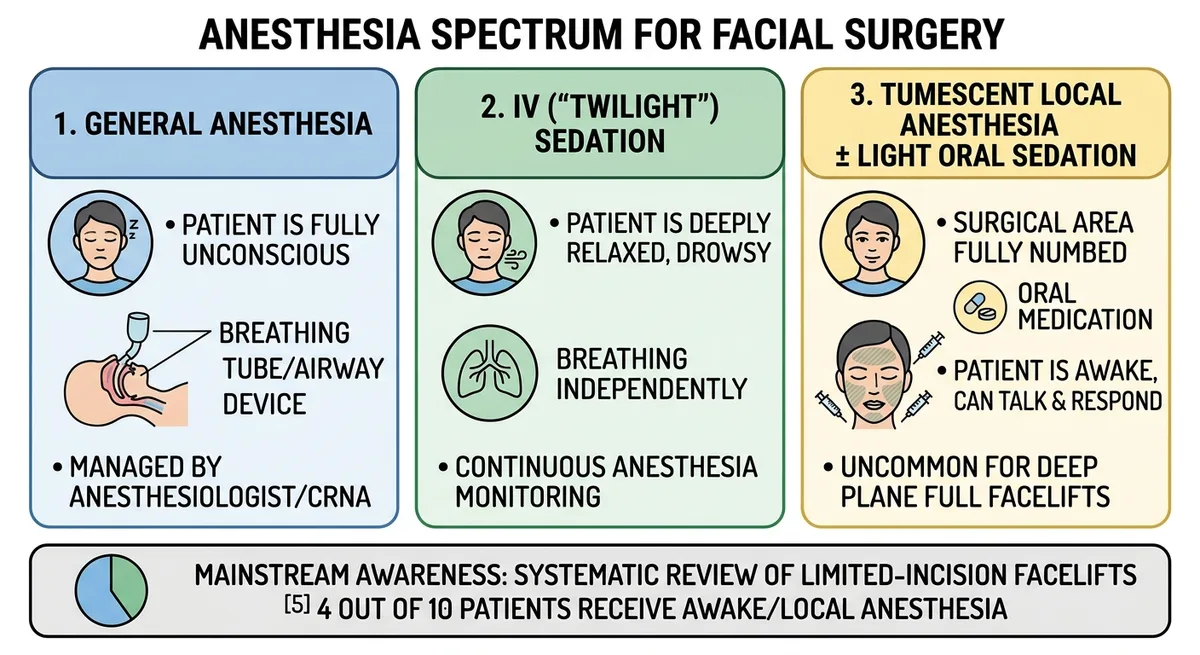
It helps to see the full spectrum of anesthesia options for facial surgery:
- General anesthesia — you are fully unconscious with a breathing tube or airway device, managed by an anesthesiologist or certified registered nurse anesthetist (CRNA). This is probably the most common approach nationwide.
- IV (“twilight”) sedation — you are deeply relaxed and drowsy through an IV, breathing on your own, with anesthesia monitoring. An increasing number of surgeons use this route, especially those with their own surgical facility credentialed for IV sedation.
- Tumescent local anesthesia ± light oral sedation — the surgical area is fully numbed; you are awake or lightly drowsy, comfortable, and can talk and respond. This remains uncommon for a full deep plane facelift — which is exactly the procedure I perform awake.
A systematic review of limited-incision facelifts found that roughly four in ten patients in the published literature had their procedure done awake under local anesthesia, with others under IV or general — showing just how mainstream the awake approach has become in facial surgery.[5]
Why avoiding general anesthesia can lower certain risks
Much of the appeal of an awake facelift is not what it adds, but what it removes. General anesthesia is very safe in modern hands, but it carries its own set of risks and after-effects that simply don’t apply when you avoid it:
- Less grogginess, confusion, or prolonged “anesthesia hangover” — most awake-facelift patients are alert and walking shortly after surgery.
- Less post-operative nausea and vomiting, a common and unpleasant side effect of general anesthesia.
- No breathing tube, and none of the rare airway or ventilation risks that come with being fully under.
- Lower swings in blood pressure during induction and emergence from general anesthesia.
- A likely lower risk of blood clots (deep vein thrombosis), because you are mobile sooner and your circulation is less affected.
On that last point, a multicenter survey of surgeons performing facelifts under local anesthesia with light sedation reported a venous thromboembolism (blood clot) rate of roughly one event in every 5,844 procedures — a very low figure, and one that reinforces why many facial surgeons favor this approach.[4]
Is it actually safe? What the published data show
It’s one thing to say awake facelifts avoid certain risks; it’s another to show the approach itself is safe. Here is where the published evidence stands.
Long-term outpatient safety
A 10-year retrospective study of facelift with platysmaplasty performed under tumescent local anesthesia in an outpatient setting evaluated safety, efficacy, and patient satisfaction, and supported TLA as a reliable approach for appropriately selected (healthy, ASA I–II) patients.[6] Published series have also shown that even a deep plane facelift — one of the more advanced lifting techniques — can be performed comfortably under tumescent local anesthesia.[8]
Tumescent technique reduces complications
In a comparative trial of 678 consecutive facelifts, tumescent infiltration significantly reduced the rate of complications compared with non-tumescent technique.[3] The dilute local-with-epinephrine solution does double duty: it numbs the area and limits bleeding, which is central to a safe awake procedure.
The local anesthetic itself has a wide safety margin
Tumescent lidocaine — the same class of dilute local anesthesia used in awake facelifts — has an extensively studied safety record. In a series of 3,240 consecutive liposuction cases performed exclusively under tumescent local anesthesia, the technique proved safe when dosing guidelines were followed.[7] The key phrase is “when dosing guidelines are followed”: safety depends on a surgeon who calculates and respects maximum lidocaine limits.
My anesthetic dosing — by the numbers (for a typical 70 kg adult)
Because “is the local anesthetic safe?” is really a dosing question, here is exactly what I use. For the incisions and the trigeminal nerve blocks I use no more than 30 mL of a 50:50 mix of 1% lidocaine with epinephrine and 0.25% bupivacaine (Marcaine). For the rest of the face and neck I use a dilute, Klein-type tumescent solution — 30 mL of 1% lidocaine with epinephrine plus TXA diluted to 1,000 mL, which is about 0.03% — and I infiltrate roughly 200 mL of it, slowly.
Blocks and nerve blocks: 30 mL of the 50:50 mix delivers about 150 mg of lidocaine and about 37.5 mg of bupivacaine — each on its own well under the conventional single-agent limits (roughly 490 mg of lidocaine with epinephrine, and about 175 mg of bupivacaine, for a 70 kg adult).
Tumescent (face and neck): because the solution is dilute and contains epinephrine, the lidocaine is absorbed far more slowly and peaks at much lower blood levels than the same dose given concentrated — the pharmacologic basis of the tumescent technique. At about 0.03%, the roughly 200 mL I use carries only about 60 mg of lidocaine.
Combined, for a 70 kg adult: about 210 mg of lidocaine in total — roughly 150 mg from the blocks plus about 60 mg in the tumescent, or about 3 mg/kg. That is below even the conventional 7 mg/kg ceiling for lidocaine with epinephrine, and a small fraction of the 35 mg/kg[9] to 55 mg/kg[10] established for the tumescent technique, which modern dosing models support.[11] The bupivacaine (about 0.5 mg/kg) is well under its maximum.[12] Dilution, epinephrine, slow infiltration, capped volumes and monitoring keep the margin wide.
Most of the facelift-under-local literature is retrospective — single-surgeon series and surveys rather than large randomized trials (Level 4 evidence). It would be very difficult to run a prospective randomized trial that split similar patients into general-versus-local anesthesia for their facelift. The evidence is reassuring, but it is not the highest tier — which is exactly why surgeon experience and patient selection matter so much, and why you should ask any surgeon how often they perform awake facelifts.
Managing the number-one facelift risk: hematoma
Across all facelift techniques and anesthesia types, the most common significant complication is a hematoma — a collection of blood under the skin that may need to be drained. This risk exists whether you’re awake or asleep, so how a surgeon manages it tells you more about safety than the anesthesia label does.
Good control starts with the tumescent solution itself (the epinephrine constricts blood vessels), continues with meticulous cautery and hemostasis during surgery, and can be reinforced with a hemostatic net — a temporary quilting-suture technique that gently tacks the skin down to eliminate the space where blood could collect. I use this technique routinely; you can read why in my article on the hemostatic net in facelift and brow-lift surgery. Controlling blood pressure before, during, and after surgery is equally important — one more reason careful patient selection matters.
Who is — and isn’t — a good candidate for an awake facelift
An awake facelift is an excellent option for many people, but not everyone. In general, good candidates are:
- Generally healthy (ASA physical status I–II), with well-controlled blood pressure.
- Comfortable with the idea of being awake and relaxed during surgery rather than fully unconscious.
- Not on blood thinners that can’t be safely paused, and non-smokers (or willing to stop well before and after surgery).
- Seeking a facelift, neck lift, or deep plane lift that can be appropriately performed under local anesthesia.
It may not be the right choice for patients with significant anxiety who would prefer to be fully asleep, certain complex or revision cases, or those with medical conditions that make local-only management less predictable. The honest answer for any individual comes from a consultation and medical review — not from a blog post.
What the experience is actually like, start to finish
- Before surgery: a consultation and medical review confirm you’re a good candidate, and we plan your anesthesia and the extent of your lift together. I use an Enhanced Recovery After Surgery (ERAS) protocol — medications such as gabapentin (Neurontin), celecoxib, acetaminophen, an antibiotic, and ondansetron — to keep you comfortable and minimize nausea. Read more about my ERAS protocol.
- The day of: you arrive and take light oral sedation if planned (typically Halcion/triazolam); we wait until you’re comfortably groggy, then numb the surgical areas with tumescent local anesthesia.
- During: you’re comfortable and relaxed — many patients listen to music, chat, or doze. You can tell us if you feel anything, and more numbing is simple to add.
- After: because you avoided general anesthesia, you can walk out of the clinic — though we always escort you to your vehicle by wheelchair as a precaution — with less nausea and grogginess, and you go home the same day. The numbing typically lasts into the evening, and you continue the ERAS medications to stay comfortable. Most patients head home, have a little lunch or dinner, and take a nap; when I call to check in that evening, the vast majority don’t remember much about the procedure at all.
How I approach local-anesthesia facelifts in Austin
Facial anatomy is my academic home: I’ve published peer-reviewed work on facelift anatomy and midface aging in Facial Plastic Surgery and Facial Plastic Surgery Clinics of North America.[1,2] That foundation is what allows me to perform even a deep plane facelift safely and comfortably under local anesthesia. Every plan is individualized — some patients are ideal for an awake approach, and some are better served another way, and I’ll tell you honestly which group you’re in.
If you want the practical, step-by-step view of the procedure and recovery, see my companion article, how to have a deep plane facelift under local anesthesia and recover fast.
Frequently asked questions
Will I feel pain during an awake facelift?
No. The surgical areas are fully numbed with tumescent local anesthesia before anything begins, and more can be added instantly if you feel anything. Most patients describe pressure or movement, not pain.
Will I be awake the entire time?
You’ll be comfortable and relaxed, often lightly sedated. Some patients stay fully awake and chat; others drift in and out. You are never under general anesthesia, so you breathe on your own and recover quickly.
Is it safe if I have high blood pressure?
It can be, but only if your blood pressure is well controlled before and during surgery — blood-pressure control is directly tied to the risk of hematoma. The key is that you don’t feel pain during the procedure: when patients aren’t feeling what I’m doing, their heart rate and blood pressure stay in the normal range. This is all reviewed carefully at your consultation and medical clearance.
Does “awake” mean a smaller or lesser result?
No. The anesthesia method is separate from the lift itself. A full deep plane facelift can be performed under local anesthesia; being awake doesn’t limit the technique or the result.
How is recovery different from a facelift under general anesthesia?
You typically avoid the grogginess, nausea, and “anesthesia hangover” of general anesthesia, so many patients feel clearer and more mobile the same day. The facial healing timeline itself is similar — though in my own experience, performing the same techniques awake rather than under general anesthesia tends to produce noticeably less bruising and swelling.
Is an awake facelift cheaper?
Often, yes. Without anesthesia fees — and frequently facility fees — the procedure can cost less. This varies by surgeon and how they set their pricing. At Levesque Plastic Surgery we break down every cost in your personalized quote after your consultation, and you can see starting prices for a typical procedure on our Menu of Services & Pricing.
The bottom line
For healthy, well-selected patients, a facelift under tumescent local anesthesia is a safe, well-supported option that removes several risks of general anesthesia and can make recovery smoother. As with any surgery, safety comes down to candidacy, technique, and an experienced surgeon — not a label. The best way to know whether it’s right for you is an honest, personalized evaluation. Request a consultation to find out which approach fits your anatomy, health, and goals.
References
All citations are real, indexed publications; links open the PubMed or journal record.
- Levesque AY, De la Torre JI. Facelifting: Anatomic Considerations. Facial Plast Surg. 2014;30(4):373–379. PubMed
- Levesque AY, De la Torre JI. Midface Anatomy, Aging, and Aesthetic Analysis. Facial Plast Surg Clin North Am. 2015;23(2):129–136. PubMed
- Jones BM, Grover R. Reducing complications in cervicofacial rhytidectomy by tumescent infiltration: a comparative trial evaluating 678 consecutive face lifts. Plast Reconstr Surg. 2004. PubMed
- Venous thromboembolism after facelift surgery under local anesthesia: results of a multicenter survey. PubMed
- Safety and Effectiveness of Limited Incision Facelifts: A Systematic Review and Meta-analysis. PubMed Central
- SMAS Plication Facelift and Platysmaplasty Under Tumescent Local Anesthesia: A 10-Year Retrospective Evaluation of Safety, Efficacy, and Patient Satisfaction in an Outpatient Setting. Aesthetic Plast Surg. PubMed
- Habbema L. Safety of liposuction using exclusively tumescent local anesthesia in 3,240 consecutive cases. PubMed
- Awake Rejuvenation With the Deep Plane Face Lift and Extended Deep Neck Contouring. PubMed
- Klein JA. Tumescent technique for regional anesthesia permits lidocaine doses of 35 mg/kg for liposuction. J Dermatol Surg Oncol. 1990;16(3):248–263. PubMed
- Ostad A, Kageyama N, Moy RL. Tumescent anesthesia with a lidocaine dose of 55 mg/kg is safe for liposuction. Dermatol Surg. 1996;22(11):921–927. PubMed
- Klein JA, Jeske DR. Estimated Maximal Safe Dosages of Tumescent Lidocaine. Anesth Analg. 2016;122(5):1350–1359. doi
- Bupivacaine (Marcaine): an evaluation of its tissue and systemic toxicity in humans. PubMed