Cosmetic Surgeon vs.
Plastic Surgeon
"Cosmetic surgeon," "facial plastic surgeon," "board certified" — the titles sound alike but the training behind them is not. Here’s what they really mean, and how to choose safely.




Not every "surgeon" trained the same way
When you're researching cosmetic surgery, the titles can blur together — plastic surgeon, cosmetic surgeon, facial plastic surgeon, all described as "board certified." They sound interchangeable. They are not. The training behind each is very different, and in most states any licensed physician can legally perform cosmetic procedures and advertise as a "cosmetic surgeon" — regardless of whether their residency was in surgery at all.
This isn't about status. It's about who is standing over you if something unexpected happens in the operating room. Understanding what the credentials actually mean is one of the most important things you can do before choosing a surgeon — so here's a plain-English guide.
"Board certified" — but by which board?
The phrase "board certified" only means something once you know which board did the certifying. The gold standard is a board recognized by the American Board of Medical Specialties (ABMS) — the body that oversees the 24 legitimate medical specialty boards in the United States. An ABMS board sets rigorous, standardized training and examination requirements.
The catch: there are also self-designated boards that are not recognized by the ABMS. A physician can be genuinely "board certified" by one of these and still not have completed a surgical residency in the field they're operating in. The certificate is real; the training behind it may be very different from what patients assume. That's why the specific board name matters more than the words "board certified."
Plastic surgeon vs. facial plastic surgeon vs. cosmetic surgeon
| Title | Certifying board | Core training | Scope |
|---|---|---|---|
| Plastic Surgeon | American Board of Plastic Surgery (ABPS) — ABMS-recognized | A dedicated plastic surgery residency (typically 6+ years of surgical training), covering surgery of the face, breast, and body plus reconstruction. | The whole body — face, breast, body contouring, reconstructive and cosmetic surgery. |
| Facial Plastic Surgeon | Often the American Board of Otolaryngology (ENT, ABMS-recognized) plus the American Board of Facial Plastic & Reconstructive Surgery (ABFPRS) | An ear-nose-throat (otolaryngology) residency, focused on the head and neck, often with a facial-plastics fellowship. | Face and neck only — e.g., rhinoplasty, facelift, eyelids. Not trained for breast or body surgery. |
| Cosmetic Surgeon | Commonly the American Board of Cosmetic Surgery (ABCS) — not ABMS-recognized | Certification is typically earned via a post-residency cosmetic-surgery fellowship. The physician's original residency may be in a non-surgical field (for example, dermatology, family medicine, or internal medicine). | Varies widely by the individual's background; "cosmetic surgeon" is not itself an ABMS specialty. |
None of this means a cosmetic or facial-plastic surgeon can't be skilled — many are excellent within their scope. The point is simply that the titles don't tell you the same thing, and a patient deserves to know the difference. A facial plastic surgeon operating on the face is within their training; the same title performing a mommy makeover or body lift is not.
Why the difference matters for your safety
Cosmetic surgery is real surgery, with real risk. When you choose a surgeon whose residency was a full plastic surgery training program, you're choosing someone who has spent years managing not just the aesthetic result but the complications — bleeding, anesthesia issues, wound healing, reconstruction — across the entire body. That depth is exactly what you hope you'll never need, and exactly what matters most if you do.
Two other signals travel with strong training and are worth checking:
- Hospital privileges. Hospitals independently vet a surgeon's credentials before granting privileges. A surgeon who could perform your procedure in a hospital — even if they operate in an office suite — has cleared that bar. (See where Dr. Levesque operates.)
- An accredited surgical facility. Accreditation (by AAAASF, AAAHC, or Medicare) means the operating environment meets hospital-level safety, equipment, and emergency standards. (Our accredited surgery centers & hospitals.)
How to verify a surgeon in five minutes
You don't have to take anyone's word for it. Before you book, verify:
- Confirm ABMS certification for free at CertificationMatters.org, and ABPS status specifically at abplasticsurgery.org.
- Ask which board certified them — and whether it's ABMS-recognized.
- Ask where they have hospital privileges, and whether their surgical facility is accredited.
- Check their state medical license and any board actions.
- Look at real before-and-after photos of their own patients for the specific procedure you want.
Questions worth asking
- 1Are you certified by the American Board of Plastic Surgery, and is that board ABMS-recognized?
- 2Was your residency training specifically in plastic surgery?
- 3Do you have hospital privileges to perform this procedure?
- 4Is your surgical facility accredited, and who provides the anesthesia?
- 5Can I see before-and-after photos of your own patients for this exact procedure?
A board-certified plastic surgeon, by every measure
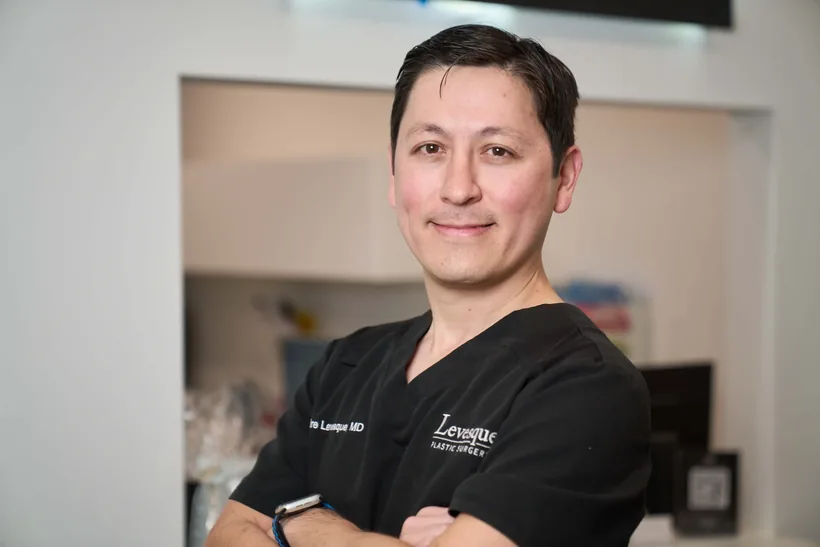
Dr. Andre Y. Levesque is certified by the American Board of Plastic Surgery — the ABMS-recognized standard — after completing full plastic surgery training covering the face, breast, and body. He operates in an accredited facility and holds hospital privileges, and is a member of the American Society of Plastic Surgeons and The Aesthetic Society.
We share this guide not to disparage anyone, but because an informed patient is a safer, more confident patient. When you understand what the credentials mean, you can choose with clarity — wherever you ultimately go. Learn more about our safety standards or meet Dr. Levesque.